Basic Electrical, Electronics And Instrumentation Engineering: UNIT I: Electrical Circuits
Ac Circuits - Introduction
Uptill now we have analysed and studied the performance of DC supply and DC circuits. But 90% of electrical energy used now a days is a.c in nature. Electrical supply used for commercial purpose is alternating.
AC
CIRCUITS - INTRODUCTION
Uptill
now we have analysed and studied the performance of DC supply and DC circuits.
But 90% of electrical energy used now a days is a.c in nature. Electrical
supply used for commercial purpose is alternating. The d.c supply has constant
magnitude with respect to time.
The
use of DC is limited to a few application like:
→
Electroplating
→
Electric traction
→
Charging of batteries
→ Electronic circuits etc.
Alternating Current
An
Alternating Current (a.c) is the current which changes periodically both in
magnitude and direction.
AC Waveforms:
The
waveforms of most alternating currents represents gradual changes in voltage
and current i.e., first increasing in one direction upto a maximum value and
decreases to zero. Then it increases in other direction (opposite) upto the
maximum value.
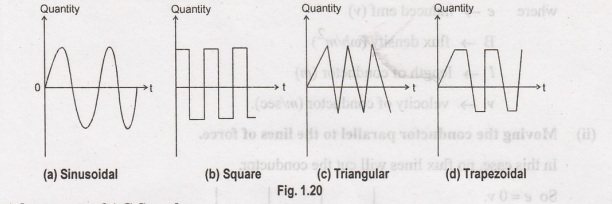
Various
types of alternating waveforms along with sinusoidal are shown in the Figure
1.20(a), (b), (c), (d).
Advantages of AC Supply:
1.
The voltages in AC supply can be raised or lowered with the help of a device
called transformer. But in dc supply this is not possible.
2.
When the high voltage is transmitted in the transmission line, the current will
be minimum. Hence the 12R loss in the conductor will be minimum and
therefore transmission system will be efficient and economical.
3.
A.C electrical motors are simple in construction, are cheaper and require less
attention from maintenance point of view.
4. Whenever it is necessary ac supply can be easily connected to obtain dc supply. 1.9
Basic Electrical, Electronics And Instrumentation Engineering: UNIT I: Electrical Circuits : Tag: : - Ac Circuits - Introduction
Basic Electrical, Electronics And Instrumentation Engineering: UNIT I: Electrical Circuits
Under Subject
Basic Electrical, Electronics and Instrumentation Engineering
BE3252 2021 Regulation | 2nd Semester Civil Dept 2021 Regulation
Related Subjects
Professional English II
HS3251 2nd Semester 2021 Regulation | 2nd Semester Common to all Dept 2021 Regulation
Statistics and Numerical Methods
MA3251 2nd Semester 2021 Regulation M2 Engineering Mathematics 2 | 2nd Semester Common to all Dept 2021 Regulation
Engineering Graphics
GE3251 eg 2nd semester | 2021 Regulation | 2nd Semester Common to all Dept 2021 Regulation
Physics for Electrical Engineering
PH3202 2nd Semester 2021 Regulation | 2nd Semester EEE Dept 2021 Regulation
Basic Civil and Mechanical Engineering
BE3255 2nd Semester 2021 Regulation | 2nd Semester EEE Dept 2021 Regulation
Electric Circuit Analysis
EE3251 2nd Semester 2021 Regulation | 2nd Semester EEE Dept 2021 Regulation
Physics for Electronics Engineering
PH3254 - Physics II - 2nd Semester - ECE Department - 2021 Regulation | 2nd Semester ECE Dept 2021 Regulation
Electrical and Instrumentation Engineering
BE3254 - 2nd Semester - ECE Dept - 2021 Regulation | 2nd Semester ECE Dept 2021 Regulation
Circuit Analysis
EC3251 - 2nd Semester - ECE Dept - 2021 Regulation | 2nd Semester ECE Dept 2021 Regulation
Materials Science
PH3251 2nd semester Mechanical Dept | 2021 Regulation | 2nd Semester Mechanical Dept 2021 Regulation
Basic Electrical and Electronics Engineering
BE3251 2nd semester Mechanical Dept | 2021 Regulation | 2nd Semester Mechanical Dept 2021 Regulation
Physics for Civil Engineering
PH3201 2021 Regulation | 2nd Semester Civil Dept 2021 Regulation
Basic Electrical, Electronics and Instrumentation Engineering
BE3252 2021 Regulation | 2nd Semester Civil Dept 2021 Regulation
Physics for Information Science
PH3256 2nd Semester CSE Dept | 2021 Regulation | 2nd Semester CSE Dept 2021 Regulation
Basic Electrical and Electronics Engineering
BE3251 2nd Semester CSE Dept 2021 | Regulation | 2nd Semester CSE Dept 2021 Regulation
Programming in C
CS3251 2nd Semester CSE Dept 2021 | Regulation | 2nd Semester CSE Dept 2021 Regulation