Basic Electrical, Electronics And Instrumentation Engineering: UNIT I: Electrical Circuits
Nodal Analysis
Examples
A junction point in an electrical circuit is called anode. A potential drop is measured with respect to this point and another node acting as a reference point. Generally ground is taken as a reference point.
NODAL
ANALYSIS
A
junction point in an electrical circuit is called anode. A potential drop is
measured with respect to this point and another node acting as a reference
point. Generally ground is taken as a reference point. If n is the number of
node then the number of independent KCL equations in nodal analysis is (n - 1)
because one node acts as a reference node.
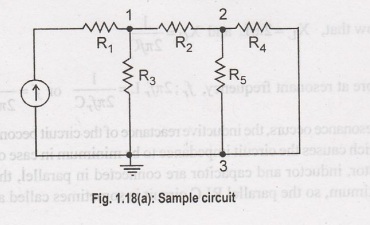
Consider
a sample circuit shown in Figure 1.18(a).

The
above nodal equations for node 1 and 2 are used to find the voltages at each
node.
Steps Involved in Nodal Analysis
Step 1:
Identify all independent nodes wherever the current branches out and select a
references node.
Step 2:
Write the nodal equation using KCL for all nodes except the reference node.
Step 3:
Nodal equations are then solved to find nodal voltages and branch currents.
Example 1.9:
Using nodal analysis determine nodal voltages for the circuit shown in of figure
below.
Solution:

Example 1.10:
Find the unknown voltage V, in the circuit shown in figure below. Assume V1
= 16 V

Example 1.11:
For the given circuit write the node voltage equations and determine the
currents in each branch for the given network.

Example 1.12: For
the circuit shown below using nodal analysis find the voltage V, which makes
the current in 10 ῼ as zero.

Example 1.13:
For the circuit find the voltage across the 6 2 resistor by using nodal
analysis.

Basic Electrical, Electronics And Instrumentation Engineering: UNIT I: Electrical Circuits : Tag: : Examples - Nodal Analysis
Basic Electrical, Electronics And Instrumentation Engineering: UNIT I: Electrical Circuits
Under Subject
Basic Electrical, Electronics and Instrumentation Engineering
BE3252 2021 Regulation | 2nd Semester Civil Dept 2021 Regulation
Related Subjects
Professional English II
HS3251 2nd Semester 2021 Regulation | 2nd Semester Common to all Dept 2021 Regulation
Statistics and Numerical Methods
MA3251 2nd Semester 2021 Regulation M2 Engineering Mathematics 2 | 2nd Semester Common to all Dept 2021 Regulation
Engineering Graphics
GE3251 eg 2nd semester | 2021 Regulation | 2nd Semester Common to all Dept 2021 Regulation

Physics for Electrical Engineering
PH3202 2nd Semester 2021 Regulation | 2nd Semester EEE Dept 2021 Regulation
Basic Civil and Mechanical Engineering
BE3255 2nd Semester 2021 Regulation | 2nd Semester EEE Dept 2021 Regulation
Electric Circuit Analysis
EE3251 2nd Semester 2021 Regulation | 2nd Semester EEE Dept 2021 Regulation
Physics for Electronics Engineering
PH3254 - Physics II - 2nd Semester - ECE Department - 2021 Regulation | 2nd Semester ECE Dept 2021 Regulation
Electrical and Instrumentation Engineering
BE3254 - 2nd Semester - ECE Dept - 2021 Regulation | 2nd Semester ECE Dept 2021 Regulation
Circuit Analysis
EC3251 - 2nd Semester - ECE Dept - 2021 Regulation | 2nd Semester ECE Dept 2021 Regulation

Materials Science
PH3251 2nd semester Mechanical Dept | 2021 Regulation | 2nd Semester Mechanical Dept 2021 Regulation
Basic Electrical and Electronics Engineering
BE3251 2nd semester Mechanical Dept | 2021 Regulation | 2nd Semester Mechanical Dept 2021 Regulation
Physics for Civil Engineering
PH3201 2021 Regulation | 2nd Semester Civil Dept 2021 Regulation
Basic Electrical, Electronics and Instrumentation Engineering
BE3252 2021 Regulation | 2nd Semester Civil Dept 2021 Regulation

Physics for Information Science
PH3256 2nd Semester CSE Dept | 2021 Regulation | 2nd Semester CSE Dept 2021 Regulation
Basic Electrical and Electronics Engineering
BE3251 2nd Semester CSE Dept 2021 | Regulation | 2nd Semester CSE Dept 2021 Regulation
Programming in C
CS3251 2nd Semester CSE Dept 2021 | Regulation | 2nd Semester CSE Dept 2021 Regulation