Physics For Civil Engineering: Unit V: Natural Disasters
Fire Safety Regulations
All buildings shall satisfy certain requirements which contribute, individually and collectively, to the safety of life. The code specifies construction, occupancy and protection features that are necessary to minimise danger to life and property from fire.
FIRE SAFETY REGULATIONS
All buildings shall satisfy certain
requirements which contribute, individually and collectively, to the safety of
life. The code specifies construction, occupancy and protection features that
are necessary to minimise danger to life and property from fire.
Width
of road
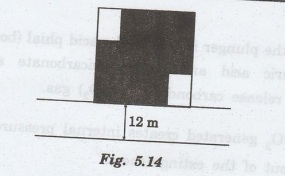
The road which abuts a high rise
building should be more than 12 metre width. The road should be hard surfaced
to carry the maximum weight of a Fire Engine. (Fig. 5.13)

Entrance
Width and Height Clearance
High rise building should have at least
2 means of access, one remote to the
other of minimum width 4.5 m with height. clearance of 5 m. This minimum width
is essential to facilitate free movement of fire units.
Setback or Open Spaces
Sufficient open space around residential
buildings, is essential to facilitate free movement and operation of Fire Service vehicles.
For
other occupancies, the setbacks shall have to be allowed as follows:
(a) Educational buildings
Except
for nursery schools, the open space shall not be less than 6 meters.
(b) Institutional buildings
Open space shall not be less than 6
meters.
(c) Assembly building
Except in front, open space shall not be
less than 6 meter and front open space shall not be less than 12 meters.
(d) Business Mercantile and storage building
Open space around the building shall not
be less than 4.5 meters. It can be relaxed in certain circumstances.
(e) Industrial Hazardous building
stat Minimum 4.5 meters open space shall
be kept around the building for the height upto 16 meters. Open space shall be
increased by 0.25 meters for next each 1 meter height of the building.
Car
parking in setback / Open spaces
If the setback area open spaces is more
than 12 meter, the provision for car parking can be done in the setback or open
spaces at the periphery of the courtyard leaving the 6 meter motorable road
(Fig. 5.15).

Car
parking
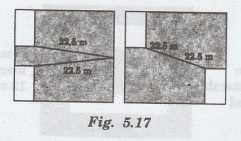
Car parking shall have to be done at the
basement with provision for minimum 2 ramps one remote to other (Fig. 5.16).

Staircases
• Every high rise building should have
minimum 2 staircases.
• Width of staircases varies from 1 m to
2 m.
• For residential building width of
staircases should be 1 m.
• Out of 2 staircases, 1 can be used as
a fire escape staircase
• Width of fire escape should be minimum
0.75 meter.
• Number of staircases shall be given as
per the travel distances.
• Staircase shall not be extended to
basement to prevent smoke, heat & gases.
• Access to the basement from the ground
should be diw through a separate staircase, which is not connected to main
staircase (i.e., It should be remote to each other.)
• Staircase shall be of enclosed type to
prevent entry of smoke & fire to the staircase.
• Spiral staircase shall be provided
upto 9 metre height.
• External staircase normally shall not
be allowed.
Lifts
• Minimum 1 lift capable of carrying
minimum persons weighting 545 kg shall be provided for every high rise
building.
• Landing
doors of lifts shall open to ventilated lobby & shall have a fire
resistance of 1 hour.
• One lift shall be designed as a
"Fire Lift".
• "Fireman Switch" shall be
provided for each lift.
• Lifts shall not be used as means of
evacuation.
• Collapsible gates shall not be
provided for the lift.
Fire
Alarm System
Depending on the occupancy, manually
operated electrical fire alarm system or automatic operated system shall be
provided in the building.
Every
building more than 15 m in height shall provide both manually operated
electrical fire alarm system and automatic fire alarm.
Public
Address System
Every
high rise building should have a public address system. It should have 2 way
communication to conduct evacuation in a systematic manner and to occupants on
every floor from the control room.
Physics For Civil Engineering: Unit V: Natural Disasters : Tag: : - Fire Safety Regulations
Physics For Civil Engineering: Unit V: Natural Disasters
Under Subject
Physics for Civil Engineering
PH3201 2021 Regulation | 2nd Semester Civil Dept 2021 Regulation
Related Subjects
Professional English II
HS3251 2nd Semester 2021 Regulation | 2nd Semester Common to all Dept 2021 Regulation
Statistics and Numerical Methods
MA3251 2nd Semester 2021 Regulation M2 Engineering Mathematics 2 | 2nd Semester Common to all Dept 2021 Regulation
Engineering Graphics
GE3251 eg 2nd semester | 2021 Regulation | 2nd Semester Common to all Dept 2021 Regulation
Physics for Electrical Engineering
PH3202 2nd Semester 2021 Regulation | 2nd Semester EEE Dept 2021 Regulation
Basic Civil and Mechanical Engineering
BE3255 2nd Semester 2021 Regulation | 2nd Semester EEE Dept 2021 Regulation
Electric Circuit Analysis
EE3251 2nd Semester 2021 Regulation | 2nd Semester EEE Dept 2021 Regulation
Physics for Electronics Engineering
PH3254 - Physics II - 2nd Semester - ECE Department - 2021 Regulation | 2nd Semester ECE Dept 2021 Regulation
Electrical and Instrumentation Engineering
BE3254 - 2nd Semester - ECE Dept - 2021 Regulation | 2nd Semester ECE Dept 2021 Regulation
Circuit Analysis
EC3251 - 2nd Semester - ECE Dept - 2021 Regulation | 2nd Semester ECE Dept 2021 Regulation
Materials Science
PH3251 2nd semester Mechanical Dept | 2021 Regulation | 2nd Semester Mechanical Dept 2021 Regulation
Basic Electrical and Electronics Engineering
BE3251 2nd semester Mechanical Dept | 2021 Regulation | 2nd Semester Mechanical Dept 2021 Regulation
Physics for Civil Engineering
PH3201 2021 Regulation | 2nd Semester Civil Dept 2021 Regulation
Basic Electrical, Electronics and Instrumentation Engineering
BE3252 2021 Regulation | 2nd Semester Civil Dept 2021 Regulation
Physics for Information Science
PH3256 2nd Semester CSE Dept | 2021 Regulation | 2nd Semester CSE Dept 2021 Regulation
Basic Electrical and Electronics Engineering
BE3251 2nd Semester CSE Dept 2021 | Regulation | 2nd Semester CSE Dept 2021 Regulation
Programming in C
CS3251 2nd Semester CSE Dept 2021 | Regulation | 2nd Semester CSE Dept 2021 Regulation